Tuesday, September 3, 2013
2006 Mazda MX 5 review
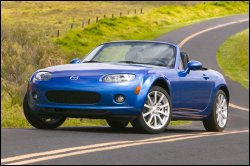 The 2006 Mazda MX-5 is a 2-door, 2-passenger convertible sports car, available in 6 trims, ranging from the Club Spec to the 3rd Generation Limited.
Upon introduction, the Club Spec is equipped with a standard 2.0-liter, I4, 170-horsepower engine that achieves 25-mpg in the city and 30-mpg on the highway. A 5-speed manual transmission with overdrive is standard. The 3rd Generation Limited is equipped with a standard 2.0-liter, I4, 170-horsepower engine that achieves 24-mpg in the city and 30-mpg on the highway. A 6-speed manual transmission with overdrive is standard.
The 2006 Mazda MX-5 is redesigned for 2006.
In the Drivers Seat
The new MX-5 interior has been improved nicely, with completely redesigned seats for better comfort and support, bottle holders in the doors, plenty of storage (even in this small a car), and some trick new features worthy of show and tell. First is the improvement in the roof operation. The top is now a Z-fold design, and has only one latch to lock in place. If you remember the old dual-latch design, we spent more time cursing it because it rarely latched correctly the first time. What a huge improvement. Plus, its a one-handed operation to raise and lower.

When you drop the roof, just push down on the top to lock it into place. No boot needed. Slick. The second cool feature is the Advance Key design that, unlike some of the bulkier keyless start systems, is the size and shape of a credit card, and easily fits in a pocket or purse. As long as the key is in proximity of the vehicle, just grab the ignition switch and turn on the MX-5. The shift knob remains compact and fits perfectly in the palm of your hand. This is one of those areas that Mazda designers attribute to their Kansei approach, where its about how the car feels in your hands... its a more emotional than strictly cold engineering level at which this car plays.
On the Road
What we love—and have always loved—about this car is its perfect balance. Another concept followed by the MX-5 Miatas creators is Jinba Ittai, which translates as: the rider and horse as one. Thats exactly how the new MX-5 feels. On the road it becomes an extension of the driver. You feel like a fighter pilot wearing a high-tech helmet that points the jet where you look. Its perfectly set up to take any corner without drama, no matter what the speed, and the shifts on the standard 5-speed manual are smooth, with direct, precise and short throws that never require more than a flick of your wrist to execute.
(Two other transmissions are available: a 6-speed manual and a 6-speed automatic with paddle shifters.)
The 2.0-liter engine now makes 170 hp and 140 lb-ft of torque, both up from the second-generation version. These numbers wont peel asphalt, but that was never the intention of the Mazda engineers. Its more about creating that perfect balance of the driver and the car. Frankly, for those of us who are true enthusiasts, this kind of driving is more enjoyable than screaming down the highway in a sedan with obscene performance specs that work great in a straight line but make your hair change color in the turns.
Sport vs Touring
Pros: great blend of comfort, milage and performence! ride not as brutal as sport. paddle shift a blast.
Cons: hard to keep under 90mph. why 4 cup holders???
If youre looking for a roadser that works as a every day car and tears up the twisting roads, this model is the one! the six speed auto/manual paddle shifter will make you forget all about a stick shift. Leave it in auto and let it do the work, (it down shifts too!) or choose manual and tear it up with the paddles, floor shift or combination of both simultainiously.
The great ride lets you explore the side roads all day without punishing your kidneys like the sport I test drove can. bottom line? if you want to stomp everyone at the autocross on the weekend, buy the club or sport model and park it during the week. If youre looking for simular performance in a great touring package you can drive all week, get a touring and get it all! Oh, did I mention the great break on insurance you get with an (automatic) sports car?

Monday, September 2, 2013
Used Car Review 1997 2001 Jeep Cherokee
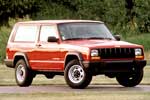 Here we go again. After that remark we made last year, the one about Jeep selling Cherokees until we are old and gray, it now appears that the Cherokees life span will continue for awhile longer. Due to "overwhelming customer demand," the Jeep people now tell us, "Cherokee production is extended past the original November 2000 close." Weve heard this before.
The Grand Cherokee was supposed to replace the Cherokee, but due to the demand for this solid, inexpensive SUV, they kept making them. Now, theyre coming out with another, smaller SUV that is supposed to replace the Cherokee. But people keep buying them.
So there is going to be a 2001 model, but after that, who knows? Jeep is eager to introduce newer, more modern, more aerodynamic products, such as the upcoming Liberty. You might want to wait and see what develops. Or you might want to buy a classic while you still can.
The four-cylinder Cherokee is already gone, which partially explains this years significantly higher base price. All 2001 Cherokees will be powered by a 4.0-liter, overhead-valve inline-6. This is the same engine that was re-designed last year for 50-state LEV (low-emissions vehicle) certification.
Highlights
Subtle styling revisions for the 1997 version of the Cherokee wagon did not disturb the popular models well-established character. Though substantial, the design alterations enhanced but did not alter the overall slab-sided look. Up front, the grille and front fascia were new, as was the bumper. Bodyside moldings were revised, and wheel arches now flowed into the front and rear bumpers. A new stamped-steel liftgate had hidden hinges, a new outside handle, and an inside pull strap. Inside, a revamped interior now included a passenger airbag, as well as one for the driver. Sound insulation was increased. A new central panel housed climate controls and the radio. New lighted power mirrors and power-window switches were installed. A new overhead console contained a storage compartment. Also new were a 5-function trip computer, and a center console with cupholders.

The Cherokee was available in base SE form with a 4-cylinder engine, as the midlevel Sport, or in top-of-the-line Country guise (the latter offered only as a 4 door model). Powertrains were unchanged. The 4-cylinder engine came only with manual shift. Standard in the Sport, the 4.0-liter inline six could have either the standard 5-speed manual gearbox or a 4-speed automatic transmission. Country wagon had the 4.0-liter engine and automatic only. Antilock braking was optional with the 6-cylinder engine. Cherokees came with rear-wheel drive or a choice of 4-wheel-drive systems. Command-Trac was a part-time system for use only on slippery surfaces. Available only with an automatic transmission, SelecTrac 4-wheel drive was a full-time system that could also be used on dry pavements.
Jeep Cherokee: Reliability
Editors have scoured repair bulletins and questioned mechanics to search for commonly occurring problems for a particular vehicle. In some cases we also give possible manufacturer-suggested solutions. In many instances these trouble spots are Technical Service Bulletins posted by the manufacturer, however, we have our own expert looking at additional vehicle problems.Air conditioner: The air conditioner gradually stops blowing cool air because the evaporator ices up. Replacing the low-pressure cycling switch usually fixes it. (1997-99)
Brake noise: Grinding and scraping noises under hard braking are caused by the driveshaft hitting the floor pan and is fixed by replacing the front lower control arm. (1997)
Brakes: The brake friction material transfers to the rotors (especially in warm, moist climates) causing brake-pedal pulsation when stopping. New pads should correct it. (1997-99)
Fuel gauge: The fuel gauge may show 1/8 to 1/4 full but the vehicle will run out of gas because of a defective sending unit that must be replaced. (1997)
Vehicle shake: Vibration at speeds over 60 mph may be due to a misaligned or defective driveshaft. (1997-98)
Windshield washer: Because of a bad check valve, windshield washer fluid drips from the nozzle for the rear window and can cause paint staining. (1997)
Driving Impressions
With its tight interior and stiff freeway ride, Cherokee might not be everyones choice for a long cruise. In fact, we suspect some people would dismiss the Cherokee as choppy on this score, and that would be true. This is not an Explorer, a sport-utility vehicle designed for people who see this breed as trendy station wagons. This is a Jeep, which means an implicit promise of off-road superiority.
Our Cherokee was equipped with the stiffer Up-Country suspension package and Selec-Trac four-wheel drive, making it even firmer than two-wheel drive versions.
Cherokee pogos a bit on uneven pavement -- certain stretches of I-80 in Pennsylvania, for example, the sections that inspire big-rig drivers to cruise in the left lane for slightly smoother going.
But on rutted dirt roads in the Pennsylvania outback, the Cherokee showed its true colors. Its combination of good ground clearance, short wheelbase and a favorable power-to-weight ratio make this boxy little veteran a tiger in the woods. The Selec-Trac four-wheel drive system, which can be used full-time, came in handy during a mini-blizzard that choked part of central Pennsylvania during this particular excursion.
Thanks to its relatively low curb weight, the Cherokee is something of an athlete among its peers. The Cherokee will smoke almost any other compact sport-utility on a slalom course, and its handier than most when its time to dodge traffic and potholes. Its on-center steering feel leaves much to be desired, however.
Cherokees optional four-speed automatic is a smooth operator, and theres enough torque in the venerable inline six-cylinder engine to generate excellent stoplight getaway, automatic or not. As always, wed prefer a manual transmission.
Power notwithstanding, the Cherokees inline-6 feels a little primitive compared to most of the V6 engines offered by Jeeps competitors. An inline-6 is supposed to be an ideal design for smooth operation, but Jeeps version generates noticeable vibration through most of its operating range.
summary
Jeep Cherokee continues to fall behind its competitors in terms of comfort and convenience. But if you value acceleration performance, the Cherokee still delivers. Its agile, and surprisingly quick.
Saturday, August 31, 2013
2007 Ford Focus RS review
 Ford Focus RS
When Ford launched its 220bhp Focus ST at the Geneva show, company officials were keeping schtum about an even hotter RS version in the pipeline. But now weve caught the flagship model undergoing cold-weather testing.
Whilst the ST, which arrives in late 2005, gets 220bhp from Volvos turbocharged five-cylinder 2.5-litre engine and is more powerful than the previous-generation Focus RS (200 bhp), the RS will be quicker still, with the T5 unit tuned for a good 250 bhp-plus and fitted in combination with the Volvo AWD system.
Ford plans hottest hatch of all
Ford is rumoured to be considering a 350bhp, four-wheel-drive, six-cylinder turbocharged proposal for the next-generation Focus RS. Right now the Blue Oval’s executives at the company’s headquarters in Cologne, Germany are considering a plan to fit Ford’s new flagship hot hatch, due out in 2007, with a new turbocharged in-line six-cylinder engine.
The advanced powerplant (right) has been developed by Volvo as a replacement for the Swedish car maker’s current six-cylinder engine, and is planned to make its debut in the new S80 due out next June.
Conceived for both transverse and longitudinal applications, the four-valve-per-cylinder unit is based around a die-cast aluminium cylinder block for an all-up weight of 180kg. It is also claimed to be 1mm shorter than Volvo’s five-cylinder engine – a feature that makes it suitable for a whole range of different models, including the new Focus RS.
Three different versions of the engine are planned: a base naturally aspirated 3.2-litre and a pair of performance-oriented turbocharged 3.0-litre units. The former receives variable cam timing (VCT) on the inlet valves, with the latter two adopting a system operating both the inlet and exhaust valves as well as a variable-vane Garrett turbocharger.
In 3.2-litre guise, the new six-cylinder produces 235bhp at 6000rpm along with 236lb ft of torque at 3500rpm – an increase of 38bhp and 26lb ft over Volvo’s current 2.9-litre engine. The turbocharged units deliver 285bhp and 295lb ft in light-pressure guise, with the high-pressure unit pumping out a BMW M3-beating 350bhp and 332lb ft.
It’s this latter specification that Ford’s Motorsport boss, Jost Capito, may use to thrust the Blue Oval back to the very top of the European hot-hatch ranks. If Ford’s plans come to fruition, the new RS will boast a whopping 133bhp and 96lb ft more than the upcoming Focus ST, whose turbocharged 2.5-litre five-cylinder engine generates 217bhp along with 236lb ft of torque.
Unlike the front-wheel-drive ST, the new RS is being developed around new four-wheel-drive underpinnings. This promises to endow it with spectacular levels of grip and traction. One problem, however, is the lack of a suitable six-speed manual transmission for the new car. The gearbox in the Mondeo ST TDCi is rated to 295lb ft, although insiders say measures are being taken to upgrade it for use in performance-oriented Volvos.
Here we go again: AutoExpress claims the new Focus RS has been canned..AGAIN!
Motoring NewsFord Focus RS
According to our sources, the firm will not use the famous RS badge on the current or imminent facelifted MkII machine - due late in 2008 - because of concerns over CO2 emissions.
One potential RS customer, who had placed a deposit for the car at his local dealership, said: "Id handed over the cash 18 months ago, not wanting to miss out. But I was told staff had to return it, as the project has been abandoned on environmental grounds."
A Ford spokesperson revealed: "Our commitment to performance cars meant that we did build a number of Focus engineering mules to test and develop high-performance parts for future products. Sadly, we never got to the point where we were ready to begin developing a business case for an RS-badged Focus."
Auto Express last scooped these cars in Issue 933. Its believed that prototypes offered around 300bhp and four-wheel drive. But the spokesperson was keen to dismiss the claim that the decision was eco-based.
"Its worth bearing in mind that its not the green issue which is driving this decision - cars have to be profitable. While Britain is the home of RS, theres not enough interest across other markets for us to earn the kind of money thats going to give the vehicle a green light," said the spokesperson.
However, there is still hope for fast Ford fans. Potential RS versions of the MkIII Focus, due in 2010, are possible.
Friday, August 30, 2013
2007 Hyundai Santa Fe Preview
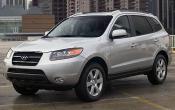 The 2007 Santa Fe continues the companys upwardly mobile ways. Built on a new unibody platform, the new Santa Fe is 7 inches longer than the outgoing model and sits on a wheelbase 3 inches longer, allowing room for a third-row seat.
 Even though its been upsized, the new Santa Fe boasts a turning circle 2 feet tighter than the outgoing version. Hyundai used some pretty lofty benchmarks, such as the Acura MDX, BMW X5 and Lexus RX 330, while developing the new Santa Fe. To that end, features such as stability control, full side curtain airbags and heated mirrors are all standard (even on the base model), and interior room is greater than that of the Lexus RX.
Two V6 engines will serve duty in the new Santa Fe — a 2.7-liter putting out about 180 hp and 180 lb-ft is standard on the base GLS model. The 2.7 is paired to either a five-speed manual or four-speed automatic. The sporty SE employs a 3.3-liter V6 with "over 230 hp and over 220 lb-ft." A manually shiftable five-speed automatic, power driver seat and 18-inch wheels are part of the SE as well. The top-of-the-line Limited has all that the SE offers, plus leather seating, heated front seats, dual-zone climate control, and chrome trim on the grille and door handles.
Two- and four-wheel-drive versions will be available across all trims, and although the Santa Fes pricing hasnt been set, Hyundai officials claim it will be "thousands less than Toyota Highlander" when it goes on sale later this year.
"When in 2006 is the 2007 Santa Fe going to be released?"
The vehicle will be on sale in the US beginning in the second quarter of 2006 -- trial production is already underway at the Alabama plant. According to one source, the vehicle will debut in Korea on Friday, the 11th of November, so we should be getting some really good stuff in the next three weeks. The official US debut (at NAIAS) is only about 2.5 months away.
Price and availability info
Well, this is the way I figured it: its lowest-priced true competitor will likely be the Mitsubishi Endeavor, which starts at $25,699. Its most expensive competitor will likely be the Subaru B9 Tribeca at $31,320. Since Hyundai generally undercuts the competition by $1,000-$3,000, I figured a $24K-$27K range would be about right.
Now, if the navigation system and Dynamic Toe Control do indeed make their way to the options sheet, a $30,000 price tag (or even a touch more) on a loaded LX AWD could be very realistic - especially since that current trim can cost up to $26K. At this point it is unclear whether the 3rd-row seat will be standard or not. So I guess Ill go ahead and revise my estimates to between $24,499 (assuming a GL 3.3-liter 5-seater as the base model) and $29,999 (for an LX AWD NAVI with a Premium Sports Package.
2007 Santa Fe will be a contender for top 3 ranking
The all new 2007 Santa Fe is going to be an exciting vehicle. Top notch fit and finish with a standard safety package which will put the great Toyota to shame.
Toyota is scrambling to respond to this safety standardization initiative from Hyundai and Honda. The racked their brains and viola - "the Star safety system" is their new marketing slogan.
Where was this "Star" system two years ago? Toyota had the audacity to bundle safety features in "packages". Want side air-bags? Buy package # 5.
If you are in the market for a SUV, I suggest you wait till the 2007 Santa Fe goes on sale. You will not be disappointed. And yes, dont insult your intelligence by falling for the "Star" marketing system.
3rd row seat of 2007 Santa Fe
One of my criteria for picking SUV is 3rd row. last week, I did test drive for Pilot and Highlander. Pilots 3rd row seat is quite roomy. its pretty good for two adults. But, highlanders 3rd row seat is terrible. its not for adults at all. only for kids.
I wonder how about 2007 Santa Fe.
I dont expect it is as big as pilot. but, I really really hope it is better than highlander.
Interesting (& some surprising) developments...
The following information is from a couple of sources; I cant confirm any of it at this time:
* Standard 3rd-row seats will be marketed as "Magic Folding".
* US advertising launch date set for 1 July 2006.
* Trims will be GLS, SE, and Limited.
* GLS comes with a new 2.7-liter CVVT V6 standard, while the SE and Limited get the 3.3-liter CVVT V6. Dont freak-out yet, though: horsepower and torque ratings havent been released, and may be higher than expected. Hyundai hasnt revealed whether or not the 2.7 is the Delta-II or an all-new engine. One source claims that its the latter (2.7 = ~220hp) and that the 3.3 is re-tuned to ~240-250hp. The 3.8-liter CVVT V6 will be standard on the larger SUV (EN), but not available --at least initially-- on the Santa Fe.
* Interior space is greater than Toyota Highlander.
* 110-volt auxiliary power outlet will be standard.
* A rear-seat DVD entertainment system will also be standard.
Thursday, August 29, 2013
2006 Mitsubishi Lancer Evolution review

If your looking at the Evo you obviously know what this car is about. Throw you back in your seat acceleration, insane cornering grip, and brakes that would have stoped the titanic. All this for a little over $30,000 and you have a car that will compete with cars costing hundreds of thousands more.
If your buying this car your looking for the thrill of driving. Not a spectacular interior but build quality is outstanding. The list of standard features is respectable with everything you would expect from a car in this price range.
The ride is a bit choppy on my small town Wisconsin roads but it does nothing to take away from the pleasure of driving this awsome machine. Be warned though. Everyone wants a ride in it and everyone wants to see what its got. This can get you in trouble. Believe me. In my opinion you cant find a better new car for the price. Excellent!
THE 2006 Mitsubishi Lancer Evolution MR is the fastest ugly car in the world. I mean that in the nicest possible way.
After all, making ugly fast is no small feat. Fast cars are typically low-slung, wide and rakish, aerodynamically optimized in the wind tunnel for high speeds and stability. Our innate sense of aesthetics responds to this kind of sleek-ifying in the same way we recognize a cheetah, a porpoise or a peregrine falcon as beautiful.
The stubby and thick Evo MR, on the other hand, is more like a rocket-powered groundhog, or a baby hippo fired out of a cannon. Fast. Ugly.
As appropriate for the name, it has taken many years of selective genetics to bring the Evo MR to its current fast/ugly nexus. The Evo line began in 1992 when Mitsubishi started building amped-up versions of its geeky Lancer sedan to compete in World Rally Championship racing.
In the next decade, while Evos tore up the WRC circuit, the ever-more-powerful street versions became the golden idols of performance pagans everywhere - everywhere, that is, except the U.S., where emissions standards made importation too expensive. This left thousands of young American men grieving in their parents basements, as the car was a star in video games such as "Gran Turismo" and "Need for Speed."
Inside and Out
Heres where it does hurt: no radio. No speakers. No power windows, no power door locks, no power mirrors, no keyless entry, no center console, no map lights. No sound deadening in the body, no carpeting in the trunk, no wiper in the rear, no paint on the naked door handles or mirrors. Amazing what we take for granted until its gone. Cant live without these life sustaining necessities? Then stay away from this track-ready Evolution RS - something that all but about 200 of Mitsubishis customers did last year. Honda sells that many Accords in two hours. On a slow day.
Since those voids can be easily filled with a step up the Evo ladder, lets focus on whats common to all Evos, most of which is common to all Lancers. Its just your basic retro-90s Japanese economy car interior: plain but perfectly functional. The few controls work exactly as expected, with a quality feel that belies their cheap appearance and new cupholders for this year. If it pleases your eye, you should have nothing to complain about. Especially if you like black.
Unique to Evos are the enveloping Recaro seats, which add side bolsters that aggressively hold you in place while maintaining the high comfort levels of the standard Lancer. There should be enough room and adjustability in them for drivers of all heights, though fatties might not fit within the narrow width. Also, those Recaro guys copied one of Volkswagens wrong answers by placing the angle adjuster on one of those frustrating knobs that must be turned ten thousand times to recline the seat one degree. And in some conspiracy against ergonomics, the knob has a freakin annoying triangular shape and is nearly impossible to reach with all that bolstering in the way. In a two-driver household, this car could inspire divorce.
Some more Evo exclusives are the Momo steering wheel (nothing wrong with this piece) and the sportier red gauges, in which the tachometer stands front and center. And of course, no other Lancer has the switch to toggle between Tarmac, Gravel, and Snow settings on the Active Center Differential.
The back seat is standard Lancer fare - adequate for two adults, possibly tolerable for three. Good legroom and footroom, but seat cushion too low, short, and soggy. The built-in head restraints are pretty flimsy, too, and there are no side air bags in any position. A mix of average-feeling leather and nice-feeling Alcantara (suede?) covers all surfaces.
The back seat doesnt fold down into the trunk like on other Lancers, no doubt to keep the car as stiff as possible. But the trunk is fairly roomy, even if, on this RS model, it looks like a looter made off in the night with the contents.
On the outside, the Evo MR looks like it went into a performance parts store and got dressed in the dark. New for this model is the inch-deep chin spoiler under the front air dam and the oval ports letting air flow around the intercoolers inlet and outlet pipes. In addition to the aluminum fender panels bulging like a can of bad Spam, the car sports a carbon-fiber rear spoiler complete with a small vertical "wickerbill" on the trailing edge. Most curious, though, is the "Vortex Generator," a row of small fins on the roof that create turbulence in the airstream over the spoiler, for an extra soupçon of downforce. Some guys have a comb-over. This car has an over-comb.
performance
The driver inputs are all perfection. The six-speed gearbox (with Teflon-coated cable linkage) is slick and affirmative. The close-set pedal position makes heel-and-toe driving effortless - and theres nothing quite like downshifting and blipping the throttle in the Evo. Frank Sinatra should have such ring-a-ding-ding. And, it will surprise no one, the steering is phenomenal. This car has one of the quickest steering ratios this side of Laguna Seca providing powerful sweeps of angular momentum with slightest inputs off center. And yet, on the freeway, the car tracks like an arrow.
This race-like responsiveness does have its downside. The rack ratio combined with the front wheels AWD linkage gives this car a truly ridiculous turning radius. Escalades are easier to park.
Of all the Evos phenomenal statistics, Im pole axed by this one in particular: Mitsubishi warranties the powertrain of this shrieking-sucking torque pig for 10 years or 100,000 miles. Holy groundhog. The car may be ugly, but that warranty is a beautiful thing.
2006 Mitsubishi Lancer Evolution MR
Base price: $36,299
Price, as tested: $36,894
Powertrain: Turbocharged and intercooled iron-block inline four, 16-valve DOHC, with variable-valve timing and dual-stage exhaust; six-speed manual transmission; full-time all-wheel-drive with active center differential; front and rear limited-slip differentials
Horsepower: 286 at 6,500 rpm
Torque: 289 pound-feet at 3,500 rpm
Curb weight: 3,285 pounds
0-60 mph: 4.5 seconds (est.)
Wheelbase: 103.3 inches
Overall length: 178.5 inches
EPA fuel economy: 18 mpg city, 24 mpg highway
Final thoughts: Revenge of the nerd
Need 4 Speed?Get u some EVO
Pros: Turbocharged goodness, 4wd, Recaro seats, smooth shifting 6-speed, awesome brakes
Cons: The speed limit, I cant drive it 24 hours a day
This car is, without a doubt, the best performing car under 35k you can buy. 0-60 in 4.5 seconds, braking from 60 in ~115 ft, and awd traction so ferocious, itll put a grin on your face everytime you take a high speed corner. Seriously folks, do yourself a favor and go test drive one (if the dealer will let you). Once the turbocharger kicks in at around 3200 RPM, youll be shoved back into your seat and before you know it, youre 2x over the speed limit. Make no mistake about it, this car isnt for the weak. Its not made for luxury or people who dont find passion in driving. This car is made for thrills and every drive in it is definately exciting. So if you want all that GPS, dual climate control, messaging seats junk, go buy yourself a Lexus. The Evo is made for hardcore motoring only.
Peace easy