Wednesday, September 11, 2013
New Car Review of the 2006 Suzuki Aerio
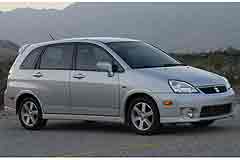 The 2006 Suzuki Aerio SX is a 4-door, 5-passenger wagon, available in 4 trims, ranging from the Base to the Premium AWD.
The Aerios styling is meant to look aerodynamic (thus the name) and distinctive. Its aimed at youthful customers and in the case of the wagon, offers plenty of space to haul their gear around. With an overall height 3 to 4 inches greater than most vehicles in its class, the Aerio boasts a surprising amount of passenger and cargo room at the cost of a chunky profile. Legroom meets or exceeds that of most competitors, and the same is true for cargo space.
Unlike most manufacturers that have a few different engines for their compact, Suzuki offers just one for its Aerio: a 2.3-liter inline four thats good for 155 horsepower. This engine offers more horsepower than most of the cars competition. On the basis of power alone, the Aerio offers impressive performance for a car in its price range. The Aerios suspension uses MacPherson struts all around, but the cars higher-than-average center of gravity results in considerable body roll. Consequently, the Aerio isnt particularly rewarding to drive, though the soft suspension does soak up the bumps without jostling the passengers, making the car a decent choice for commuters.
Driving at highway speeds isnt exactly quiet, but its not unbearable, either. The suspension transmits quite a bit of noise into the cabin and 18-wheelers sound a tad scary when you pass them, but its not bad for a commute. You just wouldnt want to spend 10 hours on the Interstate in this car.
Best of all, even the base models come with a good level of standard equipment, including automatic climate control and a CD player with MP3 capability. Other standard features include power windows, locks and mirrors, keyless entry, a rear spoiler, tilt wheel and outside temperature gauge. Thats a lot for the money.
For people who need good traction in the winter, the Aerio is the cheapest all-wheel-drive car on the market for about $2,000 more than a basic, front-wheel-drive version.
All in all, the Aerio offers a lot of car for the money, but it doesnt have the kind of refinement youd expect from, say, a Honda or Toyota -- or even a Nissan. Whether you buy one should depend on how picky you are and how much youre willing to pay for little things.
Things like decent shocks.
Interior Design and Special Features:
With an overall height 3 to 4 inches greater than most vehicles in its class, the Aerio boasts a surprising amount of passenger and cargo room, and passengers will find it easy to get in and out. Sedans offer a generous 14.6 cubic feet of trunk space; wagons provide 21 cubic feet with the rear seats in use and 63.7 cubic feet when theyre folded. Interior plastics are low in quality compared to the class leaders in the economy car segment. In the past, all Aerios had a hard-to-read digital instrument panel, but Suzuki replaced it with an analog gauge pack last year, while adding a couple of sorely needed storage areas.
Safety:
Side airbags and four-wheel antilock brakes are standard on all Aerios. In crash tests conducted by the NHTSA, the Aerio earned four stars (out of five) for its protection of the driver in frontal impacts, and three stars for front-passenger protection. NHTSA side-impact tests on an Aerio without side airbags returned a perfect five-star rating for the front seat, and four stars for the back. In frontal-offset crash testing conducted by the IIHS, the Aerio earned a "Good" rating, the highest possible. In IIHS side-impact testing, an Aerio with side airbags earned a "Poor" rating, the lowest.
Driving Impressions:
Solid power from the standard four-cylinder engine makes the Aerio impressively peppy for daily commutes; match it with either the automatic or the manual, and you cant lose. The Aerio provides a smooth ride on the highway, but the cost is excessive body roll around corners that is accentuated by the cars tall stance. Opting for the all-wheel-drive system gives the Aerio true all-weather capability.
Pros: Price and gas milage for an ALL WHEEL DRIVE great
Cons: needs more lights like the glove compartment and in rear entrance of hatchback
Alot of standard features for price. Like 6CD changer MP3 anti lock rear windsheild wiper with SX model premiem package. Good value for a cheaper AWD car.
great little car for the money, reliability is unknown. but with 7 years and 100000 miles coverage is a plus.

Monday, September 2, 2013
Used Car Review 1997 2001 Jeep Cherokee
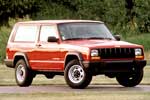 Here we go again. After that remark we made last year, the one about Jeep selling Cherokees until we are old and gray, it now appears that the Cherokees life span will continue for awhile longer. Due to "overwhelming customer demand," the Jeep people now tell us, "Cherokee production is extended past the original November 2000 close." Weve heard this before.
The Grand Cherokee was supposed to replace the Cherokee, but due to the demand for this solid, inexpensive SUV, they kept making them. Now, theyre coming out with another, smaller SUV that is supposed to replace the Cherokee. But people keep buying them.
So there is going to be a 2001 model, but after that, who knows? Jeep is eager to introduce newer, more modern, more aerodynamic products, such as the upcoming Liberty. You might want to wait and see what develops. Or you might want to buy a classic while you still can.
The four-cylinder Cherokee is already gone, which partially explains this years significantly higher base price. All 2001 Cherokees will be powered by a 4.0-liter, overhead-valve inline-6. This is the same engine that was re-designed last year for 50-state LEV (low-emissions vehicle) certification.
Highlights
Subtle styling revisions for the 1997 version of the Cherokee wagon did not disturb the popular models well-established character. Though substantial, the design alterations enhanced but did not alter the overall slab-sided look. Up front, the grille and front fascia were new, as was the bumper. Bodyside moldings were revised, and wheel arches now flowed into the front and rear bumpers. A new stamped-steel liftgate had hidden hinges, a new outside handle, and an inside pull strap. Inside, a revamped interior now included a passenger airbag, as well as one for the driver. Sound insulation was increased. A new central panel housed climate controls and the radio. New lighted power mirrors and power-window switches were installed. A new overhead console contained a storage compartment. Also new were a 5-function trip computer, and a center console with cupholders.

The Cherokee was available in base SE form with a 4-cylinder engine, as the midlevel Sport, or in top-of-the-line Country guise (the latter offered only as a 4 door model). Powertrains were unchanged. The 4-cylinder engine came only with manual shift. Standard in the Sport, the 4.0-liter inline six could have either the standard 5-speed manual gearbox or a 4-speed automatic transmission. Country wagon had the 4.0-liter engine and automatic only. Antilock braking was optional with the 6-cylinder engine. Cherokees came with rear-wheel drive or a choice of 4-wheel-drive systems. Command-Trac was a part-time system for use only on slippery surfaces. Available only with an automatic transmission, SelecTrac 4-wheel drive was a full-time system that could also be used on dry pavements.
Jeep Cherokee: Reliability
Editors have scoured repair bulletins and questioned mechanics to search for commonly occurring problems for a particular vehicle. In some cases we also give possible manufacturer-suggested solutions. In many instances these trouble spots are Technical Service Bulletins posted by the manufacturer, however, we have our own expert looking at additional vehicle problems.Air conditioner: The air conditioner gradually stops blowing cool air because the evaporator ices up. Replacing the low-pressure cycling switch usually fixes it. (1997-99)
Brake noise: Grinding and scraping noises under hard braking are caused by the driveshaft hitting the floor pan and is fixed by replacing the front lower control arm. (1997)
Brakes: The brake friction material transfers to the rotors (especially in warm, moist climates) causing brake-pedal pulsation when stopping. New pads should correct it. (1997-99)
Fuel gauge: The fuel gauge may show 1/8 to 1/4 full but the vehicle will run out of gas because of a defective sending unit that must be replaced. (1997)
Vehicle shake: Vibration at speeds over 60 mph may be due to a misaligned or defective driveshaft. (1997-98)
Windshield washer: Because of a bad check valve, windshield washer fluid drips from the nozzle for the rear window and can cause paint staining. (1997)
Driving Impressions
With its tight interior and stiff freeway ride, Cherokee might not be everyones choice for a long cruise. In fact, we suspect some people would dismiss the Cherokee as choppy on this score, and that would be true. This is not an Explorer, a sport-utility vehicle designed for people who see this breed as trendy station wagons. This is a Jeep, which means an implicit promise of off-road superiority.
Our Cherokee was equipped with the stiffer Up-Country suspension package and Selec-Trac four-wheel drive, making it even firmer than two-wheel drive versions.
Cherokee pogos a bit on uneven pavement -- certain stretches of I-80 in Pennsylvania, for example, the sections that inspire big-rig drivers to cruise in the left lane for slightly smoother going.
But on rutted dirt roads in the Pennsylvania outback, the Cherokee showed its true colors. Its combination of good ground clearance, short wheelbase and a favorable power-to-weight ratio make this boxy little veteran a tiger in the woods. The Selec-Trac four-wheel drive system, which can be used full-time, came in handy during a mini-blizzard that choked part of central Pennsylvania during this particular excursion.
Thanks to its relatively low curb weight, the Cherokee is something of an athlete among its peers. The Cherokee will smoke almost any other compact sport-utility on a slalom course, and its handier than most when its time to dodge traffic and potholes. Its on-center steering feel leaves much to be desired, however.
Cherokees optional four-speed automatic is a smooth operator, and theres enough torque in the venerable inline six-cylinder engine to generate excellent stoplight getaway, automatic or not. As always, wed prefer a manual transmission.
Power notwithstanding, the Cherokees inline-6 feels a little primitive compared to most of the V6 engines offered by Jeeps competitors. An inline-6 is supposed to be an ideal design for smooth operation, but Jeeps version generates noticeable vibration through most of its operating range.
summary
Jeep Cherokee continues to fall behind its competitors in terms of comfort and convenience. But if you value acceleration performance, the Cherokee still delivers. Its agile, and surprisingly quick.
Sunday, August 25, 2013
Car Tip What To Do In An Accident
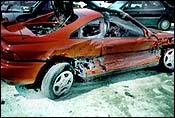 Accidents is something no one foresees happening to them. But in reality, almost everybody gets into some sort of fender bender at least once in their lifetime. When you do get into an accident, whether it is a minor fender bender or a serious collision, you need to be aware of what to do. If you are familiar with the proper protocol in dealing with a car accident, you will save yourself pain, suffering and money.
at the scene
First, you must stop if you are in an accident. Each state has its own penalties for people who flee the scene of an accident. Make sure everyone in your vehicle is all right. If there are seriously injured people, dont try to move them on your own unless they are in greater danger if left alone.
In addition, call the police, no matter how minor the accident. They will call emergency personnel if needed and fill out an accident report. A police report is important to help protect your rights if you are making an uninsured motorist claim against the insurance company.
If possible, move your car off the road so you dont cause any more accidents. Switch on emergency flashers and set out flares, if available, to warn oncoming drivers. If you dont provide proper warning for other drivers, you may be liable for damages to their vehicles.
Above all, remain calm. Do not get angry and argue with the other driver. You may be liable for any verbal or physical abuse toward other people in the accident.
get the right information
Its important to get as much as information as possible at the scene of the accident to protect yourself from potential lawsuits. Make a note of the damage to all the vehicles involved in the accident as well as weather and road conditions, date and time of the accident, speed of all cars involved, and even draw a diagram or take a picture of the accident showing the position of the vehicles before and after the accident.
Get names, addresses and telephone numbers of all the drivers involved in the accident. Also record the ownership, license plate number, year, make, and model of all the cars involved in the accident. In addition, try to get insurance information from other drivers.
Its a good idea to get the names and addresses of any people who may have witnessed the accident. These people may be helpful in a court case if there is any liability involved. Do not discuss the case with the witnesses. Do not give their names to anyone but the police, your attorney or your insurance company. Do get the name and badge number of any police officers at the scene.
Do not admit fault at the accident. Do not make any oral or written statements as to responsibility or blame. Dont tell other people involved in the accident how much liability insurance you carry. Any of these comments may be used against you in a court case. Dont accept offers to settle on the spot without carefully thinking about it. You may be held liable later for the same damages.
after the accident
Depending on state law and circumstance of the accident, you may also need to immediately report the accident to the department of motor vehicles in your state.
After the accident, it is a good idea to get checked out by a doctor. Although there may be no obvious signs of injury, there may be damage to your neck, back or spinal cord.
If needed, you may want to contact a personal injury lawyer to determine your rights and discuss liability regarding the accident.
dealing with claims
Immediately report the accident to your insurance company, no matter if you are far from home. Ask your agent about how to proceed and what forms or documents will be needed to support your claim. Make sure you include all the information you collected from the scene when you are filing a claim.
If you fail to immediately report the accident to your insurance company, it could deny any obligation to protect your interests in the event that a claim is made against you.
If a claim is made against you, refer all persons making the claims to your insurance company. Send all legal papers served against you to your insurance company. Consult your lawyer at once if the coverage you purchased is not enough to cover the claims made against you.
recovering damages
Although it may make some people uneasy, there are times when you, as an accident victim, have the right to sue a negligent driver of a vehicle for personal injury losses.
Such cases include recovery of your medical expenses and other economic losses when they exceed a certain amount of money, depending on state laws; compensation for pain and suffering if you suffer an injury that results in significant disfigurement; a fracture or other kinds of injuries as defined under the no-fault law; compensation for injury resulting in death; compensation when the injured person or the person at fault does not have insurance meeting minimum state requirements.
Its a sad fact about society that drivers must do so much to protect themselves against lawsuit, especially after something as traumatic as an auto accident. Of course, the most important thing is to make sure everyone is safe and sound. But it is crucial to get all the information you can to protect your finances rather than be sorry that you didnt in the long run.
Sunday, August 18, 2013
Used Car Review 2003 Enzo Ferrari
 Introduction
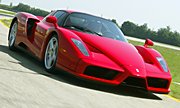
After more than a year of rumors, false names and spy photos, the Ferrari Enzo finally made its debut at the 2002 Paris Motor Show. Named in honor of the Italian auto maker’s founder, the Enzo is the latest special edition supercar to come out of Maranello. Past limited-run Ferraris have included the GTO, the F40 and most recently the F50 which celebrated the automaker’s 50th anniversary. While the initial plan was to build only 349 examples of the Enzo, Ferrari president Luca di Montezemolo announced that 50 additional Enzos would be built for a total of 399. Pricing has not been announced, but it doesn’t really matter – the entire run has already sold out.
Pros:
I like Enzo Ferrari, beacause not because of its speed & accelleration, because what it has done to racing. Since 1975, racers have been wishing to accomplish a good type & nessecery way.That is what I like about Enzo Ferrari.
Cons:
The design and styling of this car looks horrible compared to my F1. If you want the best of the best, wait until the Bugatti Veyron comes out...that car has a great chance of surpassing my McLaren F1.
Overall Review:
This car is known to be one of the greatest sport cars. It will go down in history with all of the other super cars. I have pulled many strings and worked very hard to even get a look at this car. My enzo (#274) off the assembly line is the greatest car I will ever own throughout my collection. I could tell you all of the stats and how it is so perfect in each an every way.
I could tell you that I get goos bumbs just looking at it when I take it out for a test drive on the track every two months or so, but it still wouldnt describe this car. I bought this car for me and it is the one car that will make me feel distingushed and imprtant unlike anyone else in the world. So my overall review is in the end its worth it, for me.
Over all I would recommend the Enzo to anyone with a healthy savings and a tolerance for adrenaline "jet lag". Its styling completely matches its proformance and keeps witht the flow in the way the car handles on straight aways and even corners. Dry or wet pavement, the Enzo goes toe to toe with the best I have driven and dosent miss a beat. I love the fact that no matter how let down I am about how the day has gone I can enjoy the "partnership" of an equally hard working machine. "kudos" - if you will- to Ferrari for living up to the pre-sale hype.
Tuesday, August 13, 2013
2006 Lincoln Town Car Reviews
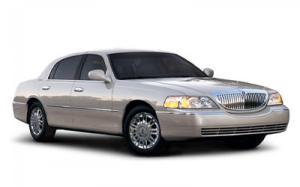 This 2003 review is representative of model years 2003 to 2006.
Below is a full, detailed 2006 Lincoln Town Car review and road test from new car Test Drive. A full evaluation of price, equipment, the driving experience, and specs are all here in a structured, easy-to-navigate format from journalists with limitless experience.
The big 2003 Lincoln Town Car is reminiscent of grand 1930s luxury cars such as the large Duesenbergs, Packards, Cadillacs and Lincolns.
Such rear-drive cars were breathtaking, especially if they had custom bodies. Even today, a 1936 Packard Twelve with a custom body by Fernandez & Darrin of Paris can stop people in their tracks.
However, Duesenbergs and Packards are long gone, and General Motors and DaimlerChrysler have abandoned the V8, rear-drive luxury sedan market—at least temporarily.
That makes the Lincoln Town Car really stand out. It has some of the visual impact of the top 1930s luxury cars because of its slick styling and large size. In fact, its the only big rear-drive V8 American luxury yacht left.
The latest version of the Town Car has gone on sale this summer as a strategically improved early 2003 model, with base prices ranging from $40,270 to $50,700.
Big car with big trunk
"Town Car customers can buy whatever they please, and their priorities are room, ride, comfort and safety," said Rick Brisson, Town Car brand manager. Indeed, the more than 17.5-foot-long Town Car is all about room. It already had the largest trunk in its class— perfect for suitcases and golf bags of all sizes. You dont have to organize them or sort them; they seem to fit back there without fuss.
Now, access to the Town Cars 21-cubic-foot trunk is improved, thanks to a wider trunk opening in the 2003 and the fact the mini-spare tire that used to intrude from a back shelf in the trunk is repositioned.
Inside, the Town Cars 45.8 inches of legroom in the front seat and minimum 41.1 inches in the back seat— 46.96 inches in the Town Car long-wheelbase trims— are noteworthy. In contrast, the Cadillac DeVille has 42.4 inches of front legroom and 43.2 inches in the back, according to Cadillac.
Likewise, the Town Cars front-seat hip room of 57.3 inches surpasses that of the DeVille and Lexus LS 430.
Limo-Style Rear Room
Most of the extra space of the longer-wheelbase trims is devoted to more rear-seat room. In fact, the long-wheelbase trims have more back seat legroom than any regular production car. However, the standard-length Town Car has plenty of rear-seat room.
One might think that the big, heavy Town Car would be clumsy, but the 2002 model was generally good in that regard and the 2003 model is significantly better.
Same engine, more power
The 2003 Town Car has the 4.6-liter, single overhead cam V8 that was in the predecessor.
But it makes more power now — 239 horsepower vs. 220 in the 2002 Town Car. Torque is up 22 lb-ft to 287 at 4100 rpm.
Its more than adequate to get the new Town Car up and moving quickly. I launched out of a parking lot and into traffic, yet easily managed to keep ahead of the oncoming cars, for example.
Shifts from the four-speed automatic transmission are smooth most of the time. There was a sharp jerk when the accelerator was depressed hard for a bit, as if the driver wanted quick acceleration, then released suddenly.
But despite the increased engine power, I didnt hear a lot of engine noise while inside the Town Car. The exception was when I had the pedal to the metal. Then, the deep sounds of a V8 at work would come through. Theyre newly tuned for a more pleasant sound this year, too. Fuel economy isnt bad for a car this big that can carry up to six passengers. The 2003 Town Car, which comes with a four-speed automatic transmission, is rated at 17 miles a gallon in the city and 25 mpg on the highway.
Improved Steering
The stiffer frame helps handling. So does the new rack-and-pinion steering, which replaces the older models less precise recirculating ball steering gear. Steering effort is low at parking speeds and rises progressively as speed goes up.
The front suspension has a more robust design with such items as upgraded shock absorbers to improve handling.
A revised rear suspension also allows better handling and reduces transmission of road impacts into the cars structure. That suspension has a stabilizer bar, and load-leveling air springs maintain a constant ride height, regardless of vehicle load.
There is a more powerful 4-wheel anti-lock brake system with a new booster that provides a "panic assist" during fast stops.

Pros:
A return to more formal styling
Suspension improvements bring better handling
Oh-so-roomy back seat, especially in L trims
Cons:
Still some floaty sensations
No head restraint for middle person in back
Some features not offered
Sunday, August 4, 2013
Car Review Ford S MAX 2 5 Titanium
 Overview
Its the most eagerly awaited new Ford since the Focus - and with sales of large family cars in freefall, its crucial to the firms success. The all-new S-MAX is the blue ovals practical vision of the future, and promises a fun driving experience and a flexible seven-seat cabin, wrapped up in a sporty body. On sale in June, the new MPV will be priced from £16,995. Its more costly than the traditional Mondeo, but is it really as good as it sounds? Auto Express got behind the wheel to find out.
Based on the daring SAV concept - which debuted at the 2004 Geneva Motor Show - the S-MAX features bold lights, a steeply slanting screen and rakish profile. As a result, it is the sportiest-looking MPV yet launched.
The styling also disguises the cars size. Longer than the current Galaxy, its only 50mm shorter than the forthcoming model - which Auto Express drove last week (issue 904). The two cars share suspension and chassis components, which will also be used to underpin an all-new Mondeo.
IN THE CABIN
Behind the wheel
The S-Maxs driving position is lower than many MPVs; its a matter of personal taste whether this suits you or not. Either way, the seats and steering wheel have plenty of adjustment, and the dash is clearly laid out and places everything in easy reach. Visibility – as with most MPVs – is compromised slightly by the four front pillars.
Space & practicality
The S-Maxs ample headroom and legroom mean that five people can sit in comfort. Access to the rear seats is good and kids will be happy there, but the low-slung seating position means adults wont relish long journeys. The five rear seats fold flat rather than lift out, and when used as a five-seater theres a huge, well shaped boot. Even with all seven seats in use, theres still space for a couple of bags.
Equipment
Every S-Max comes stuffed with airbags – there are front and side airbags for the two front seats, while window airbags cover the front two rows. Theres also an airbag next to the steering column to protect the drivers knee. Anti-lock brakes are standard, but stability control is expected to be a cost option on most models. An alarm and deadlocks are fitted to all models.
ON THE ROAD
Performance
The S-Max has two petrol engines (a 143bhp 2.0-litre unit and a 217bhp turbocharged 2.5-litre motor), and two turbodiesels (a 123bhp 1.8-litre and 138bhp 2.0-litre). So far, weve only driven the 2.5-litre petrol, which uses a version of the Focus STs engine. Our experience of the 2.0-litre diesel in the new Galaxy suggests its a good performer.
Ride & handling
Ford reckons the S-Max is an MPV for those that enjoy driving. We agree; informative steering, plenty of grip and good body control make it surprisingly sharp on twisty roads, although 2.0-litre diesel versions have a less involving steering system. When family duties take priority, the suspension is supple enough to provide good comfort.
Refinement
Although the S-Maxs large glass area creates more wind noise than many saloon rivals, it does a great job of shutting out road and suspension noise, so its an impressively quiet cruiser. Weve yet to drive all variants, but we can confirm that the 2.5-litre petrol engine is exceptionally quiet, with just a cultured rumble when extended.
Quality & reliability
The S-Maxs interior design is more conventional than rivals such as the Citroen C8 and Renault Espace, but its stylish, solidly built and there are plenty of appealing, soft-touch materials on the top of the dash and doors. Lower down and further back the plastics arent as attractive, however.
Safety & security
Every S-Max comes stuffed with airbags – there are front and side airbags for the two front seats, while window airbags cover the front two rows. Theres also an airbag next to the steering column to protect the drivers knee. Anti-lock brakes are standard, but stability control is expected to be a cost option on most models. An alarm and deadlocks are fitted to all models.
Wednesday, July 31, 2013
Used car Review 2003 Mercury Marauder
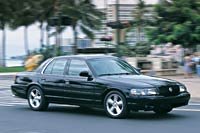 The new Mercury Marauder takes its name from the big Mercury muscle cars of the 1960s, but its true spiritual ancestors are two black Mercury sedans that starred with Jack Lord in the long-running television series Hawaii Five-O.
Lord portrayed the granite-jawed Steve McGarrett, head of Hawaiis elite Five-O police unit, his demeanor cop-show tough, his hair a perfect North Shore wave, his car no standard police-issue Ford Custom 500 or LTD but a big black Mercury in which he stormed around Oahu.
"Steve McGarretts car is as much a character in the series as any of the people." So claims Karen Rhodes in Booking Hawaii Five-O, the best and as far as we know, the only scholarly tome on the cop show.
"The big, black Mercury sets a tone of power and intimidation," she continues. "Steve is . . . tough and threatening on his own, but the black Mercury adds a further dimension of strength, even a sinister darkness, to McGarrett." Thats some pretty impressive work for a 68 Park Lane and, later, a 74 Marquis, either of which, off-screen, might have been driven by your grandfather.
wenty-two years after McGarrett screeched his big black sedan to a stop for the last time, Mercury has served up a machine perfectly suited to the marques most telegenic enthusiast. The Marauder is a badass cop car with some major attitude.
The reborn Marauder first appeared not in Honolulu but in Las Vegas, as a concept car at the 1998 SEMA show. Considering what populates the miles of aisles at SEMA--wildly winged Honda Civics with hyperkinetic paint jobs, slammed SUVs on huge chrome wheels, bikini-clad babes stroking shock absorbers--Mercurys Grand Marquis in Darth Vader livery garnered a surprising amount of attention.
Walkaround
The Marauder, in its standard ebony paint, gives the same menacing vibes as a black leather jacket. The black monochrome treatment has even been given to the headlamps with only the reflectors spared the blackout treatment. The taillamp bezels are dark tinted as well for what Mercury calls a "serious, but understated appearance."
Up front, Cibie fog lamps are inserted in the front bumper, and the rear bumper has "MARAUDER" embossed in it while big dual 3.5-inch chrome exhaust tips protrude straight out the back.
A big car needs big tires, and the Marauder wears P235/50WR18 boots on front with wider, P245/55WR18 rubber at the rear. The larger rear tires give the Marauder a natural slight rake that enhances the performance image. Five-spoke forged aluminum wheels are eight inches wide and have cast into the wheel hubs the bas-relief image of Mercury, the swift messenger of the Roman gods and a Mercury revival from the Fifties.
The current Mercury logo is centered on the grille in a bright finish; we think the gods head logo should be here as well, but Mercury did not consult us on this. The exterior, according to Mercury representatives, was purposely kept simple because focus group attendees said theyd rather have it left plain to customize themselves.
Interior Features
Like Dorothy in Munchkinland realizing shes not in Kansas anymore, the driver of the Mercury Marauder knows hes not in a Grand Marquis.
The instrument panel has white faces, with a large round speedometer and tachometer flanked by smaller fuel and temperature gauges. The 140-mph speedometer incorporates a red-lit "Marauder" graphic.
Instead of a column shifter for the automatic transmission, a leather-wrapped shifter is mounted on a floor console that has two cup holders and a storage bin. An AutoMeter (a brand known to car enthusiasts) voltmeter and oil-pressure gauge are positioned just ahead of the shifter.
Marauders are also given dot-matrix gray trim accents on the instrument panel, while the dual eight-way power seats are finished in supple black leather, the best used in any Ford Motor Company product. Classic French stitching from earlier Marauders is revived for the 2003 edition. The seats were given extra padding for greater support, and of course theres a Mercury gods head de-bossed into the front seatbacks.
The optional six-disc CD changer for the 140-watt Alpine sound system is located in the trunk, where its not as convenient, especially if the trunk is loaded, though this is a quibble brought on only by the new in-dash CD changers. There is a single CD player, as well as a cassette player for those in the retro mood or those who enjoy books on tape. (Sorry, no 8-track player, though the radios AM band works well).
Filigrees aside, the interior delivers on the promise of the exterior with lots of room inside for five. Access to the cabin is easy through large doors, and finding a comfortable driving position is easy with the 8-way power seats, tilt wheel and adjustable pedals. The front buckets are wide (so much so that the seatbelt buckle end actually protrudes through the seat bottom cushion). The seats are soft, too. The back seat is wide and soft as well, with enough room across for three adult males, though the center rider loses foot room to the driveshaft tunnel of this rear-wheel-drive car.
The trunk is huge. If you need more luggage room than this, your name is Zsa Zsa and you should FedEx your steamer trunks of gowns ahead. The trunk organizer is nice to have, with adjustable section dividers, but not really necessary and offered on the Marauder, probably, mainly because its available on the Grand Marquis.
Driving Impressions
Fire up the engine of the Mercury Marauder and youll know this is no automotive Kansas. The V8 rumble from the dual exhaust announces that the Marauder is a true American performance car. The all-aluminum 4.6-liter engine was developed specifically for the Marauder, with four-valve-per-cylinder double-overhead camshaft heads. The compression ratio is 9.85:1, requiring premium fuel.
All this yields a power rating of 302 horsepower at 5750 rpm. Peak torque is 310 pounds-feet, and comes at a relatively high 4300 rpm. Mercury engineers specified a high stall speed torque converter for the automatic transmission, which means the engine can rev higher, reaching its power band before the automatic transmission transmits power, thus producing quicker acceleration. The engineers also biased the final drive selection, a 3.55:1 rear axle, for acceleration over fuel economy. The Marauder attained an EPA rating of 17 city/23 highway, impressive for a large car, so they obviously didnt go overboard. A limited-slip rear differential is used for better traction with beefy internals for durability.
The engine tuning works, as the Marauder accelerates with authority. Very few will be able to kick sand at the Marauder in the local stoplight grand prix. The base Grand Marquis, for example, is rated at 220 bhp, the Grand Marquis LSE at 235 bhp. The 1994 Impala SS produced 260 bhp, and was considered fast for its time. How our expectations change. Still, the Marauder weighs more than two tons, so the engine has its work cut out for it. Drivers who expect the Marauder to smoke its tires at every stop sign will be disappointed. Modern tires are much better than those of the Sixties, providing too much grip for this behavior. You can still spin the tires if you work at it. But otherwise, the power goes into acceleration, not tire spinning.
As good as the engine is, the new suspension is even better.
Mercury delayed introduction of the Marauder (originally a concept car displayed at the SEMA show in Las Vegas in late 1998) to use the new chassis of the 2003 Grand Marquis. This new frame shared by the Marauder, Grand Marquis, and Crown Victoria has new stronger hydroformed front rails, a new aluminum No. 2 crossmember and is generally more robust for improved stiffness. Chassis rigidity allows better engine and suspension mounting for better handling, and less noise, vibration and harshness transmitted into the body.
To this, Mercury stiffened up the Grand Marquis suspension, using special gas-charged monotube shock absorbers and, at the rear, air springs. A new "Gripper" anti-roll bar was used up front for quicker response and a better on-center feel to the steering.
How good does it work? We tried the Marauder in two venues. One was the south course at Pocono International Raceway, a combination of the NASCAR Turn 1 high banking and a twisting road course across the infield. The track allowed acceleration onto the banking and a top speed through the big curve of around 100 mph. In almost any other family sedan, if it could go that fast, the tires would be howling in protest. The Marauder was asking for more, balanced front to rear and holding on like a championship square dancer in a power swing-your-partner.
Through the infield, the Marauder handled like a sports car, a big sports car. It was easy to place it anywhere on the track, thanks to precise variable-ratio rack-and-pinion steering. The Marauder has what racers call "good turn-in," or transition from driving straight to turning. It also has remarkable transient response, the ability to change from turning left to right and back again. Part of the credit goes to the excellent BFGoodrich g-Force T/A tires, which combine great grip with ride comfort. The only thing marring our attempt at playing Rapid Roy That Stock Car Boy were the seats, which simply lacked the lateral support to counter the lateral force the Marauder can develop, and an imprecise shifter that hobbled attempts to shift the car manually in the infield.
We were impressed with the ability of the Marauder to brake straight and sure from more than 100 mph, both the 4-wheel disc brakes to slow the vehicle and the suspension and steering to keep it under control. Out on the road, the carefully cultivated exhaust note was just as evident on acceleration, though quiet when cruising. Choppy, patched-asphalt roads highlighted the firm suspension, but the frame and body feel solid and rattle-free. Theres no apparent flex to the frame, so the bumps encountered dont result in a shuddering reverberation thats worse than the bump itself. Ride on smooth pavement is quiet, with little road or wind noise.
Summary
The Mercury Marauder is a performance car and will appeal primarily to the automotive enthusiast. Mercury expects 90 percent of buyers to be male. Not a car nut? Dont buy the Marauder. The Grand Marquis or the Ford Crown Victoria will fill your big-car bill much better, and for much less money.
That brings us to another point. We flinch at $35,000 for this car. But the four-door BMW 540i, with a 290 bhp 4.4-liter V8, costs about $55,000. The Lincoln LS with the 252-bhp 3.9-liter V8 lists for about $38,000. Of course, those cars arent directly comparable to the Marauder, which is the only car of its kind on the market today. No doubt Mercury will sell a passel of Marauders to fans of big American muscle. Ford guys who wanted a car like the Impala SS but would never buy a Chevy finally have something to buy.
Tuesday, July 30, 2013
New Car 2006 Volkswagen Passat
 Introduction
The Passat is Volkswagen’s midsize sedan, designed to offer Volkswagen owners a step up from the Jetta to the near-luxury category with a higher level of performance and sophistication. The first Passat, introduced in 1974, marked a radical departure for Volkswagen at the time with front-wheel-drive and a water-cooled engine. The Passat was completely new for the 1998 model year with more appeal to the design and slightly larger than its predecessor. The Passat is updated again for the 2006 model year.
After six generations and thirteen million examples produced, Volkswagen has enthusiastically pulled the covers off its all-new B6-generation Passat.
Completely redesigned from the ground up, the upcoming Passat will push the boundaries of what is to be expected in the midsize-car class by introducing new technologies, adding unexpected luxuries and advancing quality and overall refinement.
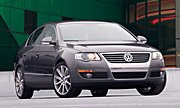
Said to be influenced by todays Passat as well as the sporty Concept C and Concept R, the all-new Passats styling is evolutionary as opposed to revolutionary. Like the recently announced Mk.V Jetta, the B6 Passat bears Volkswagens chrome-plated grille surround, with raised hood and dimpled headlamps.
Tomorrows Passat is also influenced by todays flagship Phaeton, in the form of a rounded, more contemporary shape, wing-mirror-mounted turn signals and rear LED tail lamps. VW has also adopted a body panel shaping similar to, but not quite as dramatic as BMWs flame surfacing technique; convex and concave fenders and doors make the car stand out in a world of bulbous, anonymous family sedans.
Theres some truth to that. The Passat has always been one to go its own way, with its manual transmissions, turbochargers, station wagons, all-wheel-drive, 8-cylinder engines arranged in the shape of a W, key-operated windows, and air-conditioned gloveboxes keeping things interesting. For anyone fed up with the cornucopia of sedate sedans from the Far East and Near West, VW was the only game around.
But by 2005, the somewhat small and slow Passat had fallen out of favor. The 2006 is here to address that, with acres of reinvented machinery riding atop a new platform - one that severed its former ties to the Audi family. News exists on nearly every engineering front, and several versions got lost in the model reshuffling. In other words, everything past the Passats familiar appearance really does suggest eight years worth of work.
New for 2006
The 2006 Volkswagen Passat is redesigned with a longer wheelbase and a wider body featuring a new medallion-shaped grille and clear high-tech headlights. Inside the Passat interior if more functional and ergonomic, with more rear-seat legroom and new rear vents heat and air conditioning. The Passat is powered by a new 200-horsepower 2.0-liter turbocharged intercooled engine delivering 207 lb-ft of torque from 1800 to 5000 rpm. The 280-hp VR6 narrow-angle V6 engine returns and is mated to a refined six-speed automatic transmission with Tiptronic and sport mode. The Passat wagon and 4Motion all-wheel-drive sedan will be available later in the model year.
Not a stripped car
To be sure, VW officials rightfully claim that their Passat has the lowest starting price of any midsize family car sold by a German carmaker in the U.S. Indeed, the Passat is even lower priced than Audis smaller, compact A3 hatchback.
Still, budget-conscious consumers with families may wonder why theyd want to spend so much on a midsize sedan or station wagon. They could, after all, spend less in buying a Chevrolet Impala, Honda Accord or Toyota Camry.
One thing to remember, though: The Passats pricing reflects standard equipment that might be optional on competing sedans.
For example, anti-lock brakes are standard on all Passats, but theyre optional on the base, 2006 Impala. Floor mats are standard in the Passat, but theyre not necessarily included without charge on some other cars. The Passats steering wheel telescopes as well as tilts to help drivers get comfortably situated, and the base car has a nice-looking leatherette upholstery, not cloth.
In addition, the Passat comes with a manufacturers comprehensive new-car warranty that runs for four years/50,000 miles, whichever comes first. This compares with a three-year/36,000-mile manufacturer warranty for a Camry.
The Passat also doesnt skimp on safety features. Even head-curtain airbags and front-seat side airbags are standard, and the Passat earned the top score of five stars in European crash testing.
Inside
Other innovative new technologies available on the B6 Passat include Automatic Distance Control, a sort of intelligent cruise control which uses radar to judge the speed of the vehicle in comparison to others on the road. Should a car ahead be traveling slower, ADC will automatically apply the brakes, preventing a potential collision. When the vehicle is no longer ahead, the car will accelerate, resuming the original preset speed.
Replacing the Monsoon audio system in the current Passat is an even more powerful ten-channel, 600-watt Dynaudio sound system with DVD player and LCD display. The audiophile-approved system is said to turn the Passats interior into a concert hall, but it also doubles as an on-board navigation system and hands-free telephone via a Bluetooth module.
The new, state-of-the-art Climatronic two-zone digital climate control, derived from the Phaeton, is another luxurious option which allows both the driver and passenger to tailor the cabin temperature to individual taste. The Passat will be equipped for the first time with a new intelligent starting and locking system. It does away with the conventional key, and takes the non-traditional form of a one-piece transmitter. When in close proximity to the car, the receiver automatically locks and unlocks the car. The transmitter is then slid into a holder on the dashboard, and the driver can start the car via a touch-button.
Road Test
Volkswagen has shown a recent willingness to tune their cars in line with our tastes, which means the grandest change is with engines. Just when you thought the sedan scene had settled into sanity, Volkswagen goes and punches out its V6 from a perfectly moderate 2.8 liters to a mines-bigger-than-yours 3.6. How does a 47% increase in power sound? Sounds to me like the Passats 280 horses just made it the first of its kind to pull off a 0-60 run in 5.9 seconds. Sounds like the Nissan Altima just got drop-kicked into second place. And as for the engine itself, it sounds terrific.
Technology deserves some credit here. Despite the engines heavy-handed iron construction and a loss of one valve from each cylinder (down from five to four), Volkswagens latest V6 makes more power than ever thanks to direct fuel injection, which lets the fuel bypass the intake port and squirt straight into the combustion chamber, allowing for a sky-high 12:1 compression ratio. All these changes also bless the Passats other engine, which enjoys a rebirth as a newly invigorated 200-horsepower turbo 2.0-liter 4. I sampled it on the Audi A4. It kicks.
Starting with the obvious, the power is there. Heck, its everywhere. Theres never any need to analyze whether you can pass that other car in time; you can. You can also go around town picking fights with nearly any Mustang built between 1964 and 1998 - and winning. The Passat is yet more proof that our society crossed the line of reasonable power in a front-wheel-drive car a long time ago: floor it from a stop and the tires will scream and squeal all the way to 40 MPH; try accelerating through a turn and you may not turn at all. But as long as youre already moving and the road is straight, just slam your foot down and revel in the excess acceleration. (Fun fact: Passats elsewhere on Earth start with 102 horsepower.)
Not that VW packed punch into the Passat and left the rest alone. That would be most un-German. They also did their deed with the suspension, which is now fully independent on every model (instead of just on all-wheel-drive cars) thanks to a new four-link setup in the back. They also swapped out the conventional steering rack for an electro-hydraulic type. In other news, the body is claimed to be no less than 57% stiffer in torsion than before, and the all-season tires are more aggressively sized at P245/45R17, though they also have 225 more pounds to carry.
So even if for slightly different reasons, the Passats ride and handling have the same slightly sporty slant they had before. Freeway ripples can hammer through pretty succinctly, but the suspension is comfortable enough on most roads. And while the all-season tires arent hard to overwhelm, the Passat takes a fairly willing attitude through curves. The switch to electrohydraulic steering sounded ominous, but it somehow comes off as less numb and more natural here than on the new Jetta. However, despite the slippery 0.28 drag coefficient, all that noise coming from the tires and the buffeting wind didnt seem up to autobahn standards. The last Passat did it better.
The Tiptronic automatic transmission abides by all the same rules as before, such as upshifting automatically at redline and downshifting when floored, eliminating it of much of its manual-ness. But it still shifts properly and on-time, and with a total of six gears this year, lets VW one-up (or two-up) every competitor except Mazda and Ford.
The Passat also felt familiar in a few strangely specific ways, even though the last one I drove was of a wholly different breed (a 1.8T 4Motion). Hit the gas and the Passat accelerates normally, then surges ahead once the tachometer swings past 2,000 - yup, just like a turbo engine. Turbos are fun, but wouldnt someone buying a V6 Passat expect linear V6 behavior? Also, VW still hasnt figured out how to program normal behavior into this cars brakes. The pedal is still squashy at times, especially when you press down more than halfway and the antilock kicks in, sending panicky pulsations through the pedal and making you feel like youre about to crash (though with the standard antilock and ESP stability systems, you probably wont).
So even with all the changes, weve gotten a Passat that manages to drive a lot like the last one. Mostly, thats an accomplishment.
Quality concerns
VW didnt fare well in some recent quality studies.
For example, in the 2005 J.D. Power and Associates Initial Quality Study of owners, VW was fourth from the bottom in the number of reported problems in only the first three months of ownership.
This is the poorest showing of all European marques and was only a slight improvement over the previous years ranking of second from the bottom. In 2003, VW also was below the industry average in this Initial Quality Study.
Meantime, in a look at longer-term issues, VWs from the 2002 model year ranked fourth from the bottom and worst among European brands, according to Powers 2005 Vehicle Dependability Study. The study measures problems owners report with their vehicles over the first three years of ownership.
"The Superiorly-Styled Sedan"
Pros:
The styling - interior and exterior - sets this car apart from not only its normal competitors (Accord and Camry) but also from its higher-priced rivals (BMW, Lexus, Infiniti). However, VW also drastically improved the functionality along with the form in the 2006 design. Cup holders, umbrella storage, trunk release, seat adjustments, radio controls, etc. are all very well laid out and add to the pleasant experience of getting around town in the Passat.
Cons:
Unfortunately, it is not the ecomonically-wise decision to go with the Passat over the Accord or Camry. With the requirement to use premium fuel and synthetic oils along with the steep sticker price, it costs to get in the well-styled Passat. However, it should be noted that many features are standard on the Passat that are normally upgrades on similar cars (leatherette, ABS, side air bags, turbo engine, etc.).
Overall Review:
The Passat breaks the mold in the "me-too" family sedan market. VW clearly decided it wanted the Passat to stand apart from the competition, and they succeeded. Does this make it a better car than the Accord, Camry, or other competitors? Not necessarily, but for the customer interested in a superior-styled, high performance sedan that doesnt want to spend the money on a BMW, Audi, or Lexus, the Passat is the clear winner. No one will argue that an Accord or Camry would be "cheaper-to-own" vehicles due to better gas mileage, cheaper maintenance, standard fuel, and lower sticker-prices, but the Passat serves as a strong player that should be considered. The 2.0T engine is a blast to drive around town, the interior styling (red-and-blue lights!) is a joy to experience, and the exterior looks compete with the high-end cars.
Sunday, July 28, 2013
Reviews SUV Used Car Reviews
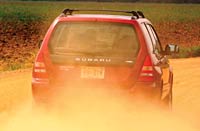
2003-2005 Subaru Forester
If it seems funny that Subaru had us test its 2003 Forester at Alabamas Talladega Superspeedway, trust me, it was. By the third time Id steered the second generation of this car-based SUV through the 2.66-mile ovals 33-degree high banks, I was grinning. By the end of my co-drivers turn at the wheel, I was laughing nonstop, so unlikely was the scene of this sensible Subaru all-wheel-driving at 85 mph over the same pocked tarmac where NASCAR stockers rub fenders at nearly 200.
I couldnt help thinking that we should have driven the new Forester on the steep ascents of San Francisco, the better to test the famous Hill-Holder clutch, which returns in the Forester after a five-year absence from the Subaru lineup. (The food would have been better in Frisco, too.) The Hill-Holder, standard with the five-speed manual, engages a pressure-holding valve when both clutch and brake pedals are depressed. Let up on the brake, and in that brief moment when your right foot is moving toward the accelerator pedal, when normally the car might roll backward toward Fishermans Wharf, the brakes stay locked until your hoof actually makes contact with the go pedal.
But we were not in San Francisco, and we do like Alabama barbecue, just as weve liked the Forester since it debuted five years ago as one of the first crossover vehicles. For 2003, changes to the wackiest Subaru are not revolutionary, but theyre noteworthy. The sheetmetal is new, with raised-eyebrow headlights and a hexagonal tailgate framing the more muscular bodywork. The stiffer chassis, derived from the new Impreza, boasts a front subframe made of hydroformed steel members.
Bigger anti-roll bars and front brakes have been fitted, and the interior has been freshened. Subarus 165-horsepower, 2.5-liter boxer four returns. You were expecting the Impreza WRXs turbo four? Dream on--the Forester is practical, not fantastical. Besides, that scenario would substantially raise the Foresters tariff, currently in the low to mid-$20,000s, and Subaru hopes to hold the line on Forester pricing, maybe even to drop it a bit on a comparably equipped basis.
The Forester has never beckoned to hot-footers, anyway, or to those people for whom all consumer goods, whether they be houses, fountain drinks, or SUVs, are better if theyre bigger. Its appeal lies in its standard all-wheel drive; modest yet functional overall size; just-right seating position--not too high, not too low, offering superb all-around visibility; useful 7.5 inches of ground clearance; and reasonable cargo capacity. If you haul around all your worldly goods, skip this one. But if you leave most of them at home, the Foresters 32.0 cubic feet of cargo space with the rear seats in place and 64.1 with them folded will serve you well. My co-driver and I hauled a seven-foot, 200-year-old grandfather clock from a rural antiques store to our Birmingham hotel (albeit with one of us riding beside it in the back seat).
The Foresters carryover strut-type four-wheel independent suspension does a decent job of damping most under-wheel intrusions, except in the truck lanes of Alabamas freeways, which can test the mettle of any cars underpinnings. Under those circumstances, we found it best to move into the left lane and give the Forester the boot. Said maneuver demonstrated that the optional four-speed automatic is hard-pressed to make the most of the engines modest torque. Go for the five-speed manual.
Side air bags, now protecting both head and chest rather than just chest, are newly standard, along with front-seatbelt pretensioners and active head restraints, and the uplevel XS model gets electronic brake-force distribution. Perhaps most interesting, though, is not what has been added but what has been taken away: weight. The Forester is about 90 pounds lighter than before, thanks to increased use of aluminum and a new welding technique for the body. Lighter is always better, whether youre flooring it at Talladega or cresting hills in Pacific Heights.
Wednesday, July 24, 2013
Car Review 2006 Kia Amanti
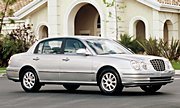 Value and quality are the 2 words we use most to describe this car. With over 10,000 miles we continue to enjoy the quiet ride, a comfortable interior, great sound system and puzzled looks from other drivers as they try to figure out if it is a Jag or a Benz.
The Amanti has a soft, buoyant ride, but has clumsy handling, although its optional ESC keeps it secure.
The V6 delivers only adequate performance, and its 18-mpg fuel economy is unexceptional. The interior boasts impressive fit and finish.
News
Amanti may get a cosmetic freshening for 2008, but nothing drastic. A complete redesign is possible for 2010, at which point Amanti would become a retrimmed sister of parent Hyundais Azera.
New for 2006
The 2006 Kia Amanti receives additional luxury equipment as standard equipment including leather seats, heated front seats auto-dimming rearview mirror with HomeLink system and power sunroof. Also new for 2006 is an available Infinity Package, which includes an Infinity 225-watt AM/FM/Cassette with a 6-disc in-dash CD changer and nine speakers including a subwoofer, two-position memory setting for the driver’s seat and outside mirrors, and a four-inch monitor, which displays trip computer information, outside temperature and digital clock.
Interior Design and Special Features
The Amantis interior seats five and offers the highest level of amenities ever offered in a Kia, such as dual-zone automatic climate control, an eight-way power-adjustable driver seat and a 270-watt audio system. The front seats offer more head- and legroom than any other full-size sedan. In back, occupants will find ample headroom as well, but the Chrysler 300, Ford Five Hundred and Toyota Avalon offer more legroom. The Amanti comes standard with a ski pass-through and trunk lid that utilizes concealed hinges with gas struts to keep from damaging cargo. Trunk capacity is 15.5 cubic feet, about average for this class.
Safety
Four-wheel antilock disc brakes are standard, while stability and traction control, Electronic Brakeforce Distribution and BrakeAssist are available via an option package. Standard seat-mounted side airbags protect front occupants, while full-length side curtain airbags protect all outboard occupants. The Amanti also has active whiplash-reducing front head restraints that move up and an anti-lockout system that keeps the doors from being locked while the key is still in the ignition. A first-aid kit is a stand-alone option. The NHTSA has not crash tested the Amanti, but it earned the top rating of "Good" in IIHS frontal-offset crash testing.
Powertrains and Performance
The Amanti is powered by a 3.5-liter V6 rated at 200 horsepower and 220 lb-ft of torque. A sharp-shifting five-speed automatic transmission gives the Amanti solid performance despite its modest horsepower. The transmission includes a manual-shift mode with an LED indicator in the instrument panel.
Driving Impressions
Like most vehicles in its class, the Amanti is tuned to provide a smooth, quiet ride with maximum isolation from the road. With only 200 horsepower, it lags behind the majority of its competitors, but theres enough power on tap for most driving situations. Its overall refinement level doesnt match the class-leading Toyota Avalon, but for those looking for an excellent value in this segment, the Amanti is a compelling choice.
Body Styles, Trim Levels and Options
The Amanti is a large four-door sedan available in a single trim level. The standard equipment list includes 16-inch alloy wheels, a full-size spare tire, dual-zone automatic climate control, a CD player, heated leather-upholstered seats with eight-way power adjustment (four-way power for the passenger), wood grain trim, a sunroof, an auto-dimming rearview mirror, steering wheel-mounted audio and cruise controls and a full set of one-touch up/down windows. Opt for the Infinity package and youll get a 270-watt Infinity sound system with an in-dash CD changer, a trip computer with a 4-inch LCD screen, and memory settings for the mirrors and driver seat.
Favorite Features: Luxury ride, similar to Lexus 400 and Lincoln Town car. Styling, luxury leather with beautiful birds eye maple wood (plastic) trim. This car is so well planned with 3 power outlets inside. Many features you can only get on Lexus, BMW & Mercedes.
2006 Kia Amanti Summary
The 2006 Kia Amanti is a 4-door, 5-passenger family sedan, available in one trim only, the Base.
Upon introduction, the Amanti is equipped with a standard 3.5-liter, V6, 200-horsepower engine that achieves 17-mpg in the city and 25-mpg on the highway. A 5-speed automatic transmission with overdrive is standard.
MSRP: $27795.00-$27795.00
Invoice: $25325.00-$25325.00
Monday, July 22, 2013
Car Reviews 2006 Dodge Viper
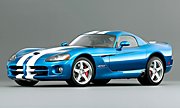 This is not just a sports car, its a dream car and it will prove it to you. want to know why ill tell you why because this viper holds over 500hp and over 500ft of torqe and tires are just fantastic.
I know it cost money but it is worth it.believe me this viper will make it worth your while get one and be amazed and believe it!
New for 2006
The 2006 Dodge Viper SRT10 convertible is joined by the all-new 2006 Dodge Viper SRT10 Coupe. The Viper SRT10 Coupe debuts in Viper Blue with Stone White Stripes in contrast to the original Dodge Viper GTS Coupe that was blue with white stripes. The “Double Bubble” roof and bold rear styling with wraparound taillights are also reminiscent of the Viper GTS Coupe. The Viper SRT10 Convertible is available in Viper Red and Viper Black, and later in the year, a “Blue Mamba” edition will be offered with a special interior package that includes black leather upholstery with contrasting stitching and shift knob accents.
News
A reliable Detroit source says Viper will skip the 07 model year, but will fill-in with tuned 06s packing 650 hp, maybe more. The tuning is the work of parent Mercedes UK-based McLaren Performance Group, which builds the exotic Mercedes SLR. Engineering is said to be all but complete, giving credence to a "super snake." No word on an introduction date, however. Aside from this prospect, Viper should see no basic change until Chrysler Group redesigns it again, which we dont see happening before 2010.
Interior
One thing the Viper doesnt lack for is interior room for two tall Americans and a little bit of stuff or luggage. On the convertible, there is a great deal more headroom than on the last folding-top Viper. The top goes up or down with one hand and latches easily. The 2006 Viper is almost a foot wider on the outside than the 2006 Corvette, but not all of that width translates into additional occupant space. Its not easy to get in or out of a Viper (or a Corvette, for that matter) with any grace, but once inside, theres plenty of comfort and lots to see.
The form-fitting tall bucket seats will hold your upper body in the corners very well, and the seat will bump up against the rear wall when extended all the way back, and thats it. No more rear travel or recline. If youre very tall, youll be more comfortable in the convertible. The floor pedals can be power-adjusted by a dashboard button through four inches of reach, a big improvement over the old manually adjustable pedals.
The new instruments and controls are canted to the left in the new car, toward the driver, and you can see all the faces in one quick left-to-right sweep of the eyes. The large tachometer sits directly in front of the driver, to its right a smaller 220-mph speedometer (but 190 is more like it). All of the switches and vents are easier to see and reach.
The throttle, brake and clutch pedals are closely spaced for heel-and-toe downshifting. A new feature is the dead pedal for your left foot, good for bracing in the corners at the race track or on your favorite country road. A returning feature is the use of acres of cheap plastic on the interior.
Safety
Safety equipment doesnt go beyond the basics on the Dodge Viper. There are no side airbags, nor is there traction or stability control. Massive four-wheel antilock disc brakes assure rapid stops and a passenger-side airbag cutoff switch makes it feasible for small children to ride along in a pinch.
Powertrains and Performance
An 8.3-liter (505-cubic-inch) V10 engine sports heroic output numbers: 510 horsepower and 535 pound-feet of torque. The power is transferred to the fat rear tires via a Tremec six-speed manual transmission and a standard limited-slip differential. Its performance numbers are equally impressive, as the Dodge Viper is able to reach 60 mph in just 4 seconds and run the quarter-mile is 12 seconds flat.
Driving Impressions
The 2006 Dodge Viper is one of the fastest production cars in the world. Its 510-horsepower V10 pushes it to triple-digit speeds in the blink of an eye and it doesnt stop there. Massive rear tires make fast starts easier than you might think, although the shifter is a bit awkward so concentration is required to hit the gates just right. Pushing this Dodge car to the limit still requires the skill of a seasoned driver, but even rookie pilots will admire the cars unbelievable abilities. Ultraquick steering, racing-style seats and powerful Brembo brakes add to the racecarlike feel. Its not comfortable enough to be used as an everyday driver, but for those who can afford to have it on the side, the Dodge Viper is a supercar that answers to nothing.
2006 Dodge Viper Summary
The 2006 Dodge Viper is a 2-door, 2-passenger sports car, or convertible sports car, available in two trims, the SRT-10 Convertible and the SRT-10 Coupe.
Upon introduction, both trims are equipped with a standard 8.3-liter, V10, 510-horsepower engine that achieves 12-mpg in the city and 20-mpg on the highway. A 6-speed manual transmission with overdrive is standard.
The 2006 SRT-10 Convertible is a carryover from 2005. The SRT-10 Coupe has been redesigned for 2006.
Favorite Features
Power, power, power. Oh yeah, the seats are probably the most supportive racing seats Ive ever experienced.
Overall Review
If you are looking to win as many circuit races as possible a new Z06 or Porsche 911 is your ticket; though this car seems to hold its own. However, if tearing down highways and gobbling up country roads and stomping punk kids in their Camaros and Cobras on the highway while turning heads everywhere you go is your thing, the SRT-10 delivers big. Ive driven plenty of cars, many of which I couldnt dream of affording or insuring for that matter, and I have the say the SRT-10 is probably the most fun Ive ever had.
Sunday, July 21, 2013
Honda wins Car Truck of Year
The Civic family was judged best new car by a panel of 49 automotive journalists in the U.S. and Canada (including yours truly), beating the Ford Fusion and Pontiac Solstice.
The Ridgeline pickup was chosen as best new truck, over Ford Explorer and Nissan Xterra.
There were a lot of happy faces at Honda Canada as well, since both of these products are built in the companys Alliston facility.
Each of the same vehicles has also won its respective category in the Automobile Journalists Association of Canada Car/Truck of the Year program; the overall car and truck winners will be announced at the Canadian International AutoShow in February. —Jim Kenzie
Saturday, July 20, 2013
New Car Overview Of The 2006 BMW 7 Series Full Size Luxury Sedan
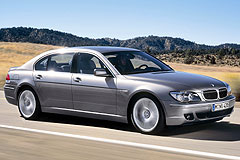 Description: Full-Size Luxury Sedan
Base MSRP Range: $71,800 - $118,900
Invoice Price Range: $65,520 - $108,380
Where built: Germany
A face-lift marks BMWs full-size 7-Series luxury/performance sedans and with it comes two powerful engines. Models include the V8-powered 750i and stretched 750Li, plus V12 versions of 760i and 760Li.
These line-topping cars bring sophisticated electronics governing power production and vehicle stability, and dazzling interactive voice commands for operating navigation, climate and communication equipment. Updated 7-Series models project a new kidney grille with revised fascias fore and aft plus xenon high intensity discharge (HID) headlamps. Also evident on the body are refined lines and more chrome highlights.
The V8 engine employed by 750i and 750Li expands in displacement from 4.4 to 4.8 liters to deliver 360 hp. The 12-cylinder engine for 760i and 760Li carries forward with a 6.0-liter aluminum plant that develops 408 hp and features BMWs Valvetronic system plus fully variable bi-VANOS camshaft controls. Both engines mate with a six-speed automatic with shift-by-wire technology.
source: womanmotorist.com
Friday, July 19, 2013
Coupe New Car Review 2006 Chevrolet Corvette Z06
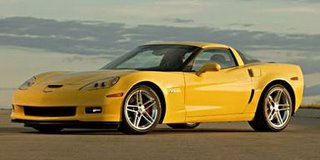 Absolutely spellbinding power, faster, more control and comfort defies its incredible low cost compared to the Ferrari 360. The engineers at GM truly deserve world wide acclaim and praise for designing this car.
The production workers at Bowling Green are perfectionist and master craftsmen and deliver to the Average Joe a Supercar that is actually attainable - pending availability!! The 2006 Corvette is the fruition of why human must continue to dream big, aim high, and never quit in the face of competition - because you can prevail, and this car does. The 505HP engine is simply the heart of this electrifying car. Whooo-EEEE!
Car and Driver magazine has also named the Chevrolet Corvette as the "Best Performance Car" for 2006 in its 24th annual roundup of the 10 best cars sold in America. It’s no wonder that the Corvette is America’s favorite sports car! The 2006 Corvette Z06 has an endurance-racing-inspired 7.0-liter power plant under the hood. It boasts 470 lb.-ft. of torque and goes from 0-to-60 mph in 3.9 seconds. At 80 mph, the massive brakes on the new Z06 stop the car in a short 109 feet. It delivers a top speed of 198 mph.
Whats New for the 2006 Chevrolet Corvette?
The new Corvette Z06 is the big news, but the standard 2006 Chevrolet Corvette Coupe and Convertible also see upgrades this year. Foremost among them is the new six-speed automatic transmission with paddle shifters, which features Drive, Sport, and Manual shift modes.
Drive works like a regular automatic; Sport engages the Corvettes Performance Algorithm Shift software; and Manual works with the paddle shifters for complete driver control. The paddles are mounted to a new, smaller-diameter steering wheel this year, and the dual-stage front airbags are upgraded with an occupant sensing system for the passengers side. Order the upgraded Bose audio system in 2006, and XM satellite radio is included (though the subscription is extra). New exterior colors include Velocity Yellow Tintcoat and Monterey Red Metallic Tintcoat, while the interior is offered in a new Titanium Gray color. On convertibles, the top is newly available in Storm Gray.
THE ENGINE
With 505 horsepower making the Corvette the fastest Vette ever! The Corvette looks great and rides great. The Jack LaLanne of the engine world, GMs small-block V-8, ripples with newfound muscle thanks to a fatter bore and a longer stroke that yield 428 cubic inches or 7.0 liters of piston displacement. Coded LS7 (in 1970, GM advertised a 460-hp LS7 big-block V-8 that was never bolted into a production car), the latest Z06s engine consists of a new aluminum-block casting liberally loaded with go-fast goodies.
A forged-steel crankshaft is supported by six-bolt forged-steel main-bearing caps and is twisted by forged-titanium connecting rods that are 25 percent lighter than the ferrous-metal rods used in the standard 6.0-liter V-8. Lighter cast-aluminum pistons sliding inside pressed-in cast-iron cylinder liners hammer the incoming charge with an 11.0:1 compression ratio. Intake and exhaust valves are lined up edge-to-edge, wall-to-wall. The 2.20-inch-diameter intakes are titanium for weight savings, and the 1.61-inch exhausts are sodium-filled for rapid heat transfer. An aggressive roller-follower camshaft kicks the valves open 13 percent wider than in the 6.0-liter V-8. All critical cylinder-head surfaces-intake and exhaust ports, combustion chambers-are fully machined to surpass the 6.0-liter engines airflow by 18 percent.
An electronically controlled 3.5-inch (90-millimeter) throttle meters air to the composite-plastic, tuned-length intake manifold, which is fed fuel by high-capacity solenoid injectors. On the exhaust side, four hydroformed stainless-steel tubes merge into one wide-mouth catalytic converter per bank. The pièce de résistance is a bona fide dry-sump lubrication system-a feature Porsche eliminated from its flat-sixes to save cost. A gerotor-type pump driven by the crankshaft evacuates oil that drains to the bottom of the block for storage in a cylindrical reservoir positioned in the right rear corner of the engine bay. A second pressure pump draws lubricant from the tank for delivery to the engines oil galleries.
The key benefit with this arrangement is that theres no chance of oil starvation when high revs mix with high-g cornering and braking. Oil capacity is greater by 2.5 quarts (8.0 versus 5.5 in regular Corvettes), and the remote reservoir helps remove trapped air from the lubricant. To clear a spot for the tank, the battery has been relocated behind the right rear wheel. The LS7 generates a husky 500 hp at 6200 rpm, with a torque curve humped up to 475 lb-ft at 4800 rpm. Thats 3.6 times the output of the original "Turbo-Fire V-8" engine that debuted in 55 Chevys, showing just how far a sound idea can go with half a century of development.
THE BODY
With an additional 100 hp available for beating back the wind, aerodynamic emphasis shifts from minimal drag to additional downforce. The Z06 has a taller front fascia slot to ram extra cooling air through the radiator plus a central nostril dedicated to engine air. A horizontal surface, called a splitter, extends forward of the fascia to help neutralize front-end lift at speed. The rear portion of the front wheel opening is reshaped, and the side vents are larger to relieve underhood pressure. The rear tires are shrouded by meatier fender flares, and forward-facing slits duct air to the rear brakes. The black spoiler affixed to the center portion of the fascia is more than twice as tall as the one used on standard Corvettes. Wind-tunnel testing is ongoing, but its clear that frontal area, drag coefficient, and wheel loadings will be increased over C6 figures.
Other features of the 2006 Z06 listed by General Motors include:
• LS7 7.0-liter/427-cubic-inch Gen IV V-8 engine with lightweight reciprocating components
• 505 horsepower (373 kw) @ 6300 rpm
• 470 lb.-ft. of torque (657 Nm) @ 4800 rpm
• 6-speed manual transmission
• 7000 rpm redline
• Aluminum body structure with one-piece hydroformed perimeter rail frame and magnesium engine cradle
• Carbon-fiber composite front fenders, front wheelhouses and floors • Dry-sump engine lubrication system
• Hand-built engine at GM’s new Performance Build Center
• Unique design styling that includes a larger grille, cold-air scoop and lower air splitter, wide-body front and rear fenders and a taller rear spoiler
• Engine, transmission and differential oil coolers and steering cooler
The new Z06 is the fastest, most powerful car ever offered by Chevrolet and General Motors. It was developed alongside the Corvette C6.R race car.
Corvette’s chief engineer Dave Hill attributes the superior performance of the 2006 Z06 to the technology and know-how from the race program.
Auto-Trex Advice :
The thrill of open-air motoring was a part of the original allure when the Chevrolet Corvette roadster was born in 1953, and the sixth-generation Corvette (C6) builds on its icon status with technical sophistication and expressive style. Todays Corvette cuts a tighter, tauter profile than the C5 it replaced - with virtually no loss of usable space. These smaller dimensions make the car more agile and tossable, with upgrades in handling, acceleration and braking.
Thanks to its strong and lightweight body structure and a 400-horsepower, 6.0-liter LS2 engine, the 2006 Chevrolet Corvette raises the bar for performance, with impressive handling, yet supple ride quality. The Corvette convertible features an optional power-operated soft top, a feature that last appeared in 1962. The power top features single-button control and completes its cycle in 18 seconds. With a near perfect blend of performance, handling and stunning looks, the 2006 Chevrolet Corvette keeps itself at the top of the American muscle car list, with Fords new Mustang bobbing in its wake. Drive one, and you wont want to relinquish the keys.
Car Review 2003 Dodge Ram
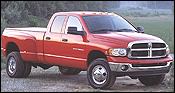 Constructed on a strong new chassis thats modular in design to allow multiple configurations for cabin size and box length, heavy-duty Ram trucks dominate the road with their forceful new exterior styling, as they also flex muscles from a new series of powerful engines designed to pull far more than their hefty weight and tow some class-topping loads.
The collection of heavy-duty Ram trucks consists of two different weight designations with 2500 (¾-ton) and 3500 (one-ton) series.
Cabs conform to a two-door Regular Cab with split bench seat, and a four-door Quad Cab with two rows of seats for as many as six passengers. Beds in back extend in lengths of "long" and "longer."
Park a Ram 3500 next to the conventional Ram 1500 (½-ton) and youll get the big picture: the heavy-duty Ram towers over the 1500 -- its so tall that the full-size 1500 Ram looks like a compact-class version of the 3500. Yet the family resemblance is quite obvious.
strong like bull
Styled with a bold exterior form for the chin-forward face, big Ram looks strong and assertive -- and impossible to miss, should the image of one suddenly appear in your rearview mirror.
A massive prow dominates the design with the stair-step hood of a big-rig Peterbilt and a flat-faced horse-collar grille thrust forward and marked in cross-hair chrome. More chrome underscores the grille on a fat-lip bumper etched with round fog lamps at both ends.
Flanks are flat but on Ram 3500 with dual rear wheels (DRW) the back fenders bulge to cover those extra tires.
On top of the high cab, five amber running lamps add a menacing touch that actually works for safe motoring to enhance the trucks visibility on the road at night.
come up for air
Safety equipment on Ram reaches beyond two frontal air bags to three-point safety belts for all seats, including three sets in the Regular Cab and six in the Quad Cab, plus sets of tether anchors in the rear of the four-door for installing a childs safety seat. Also, side curtain-style air bags in the first application for a heavy-duty truck are offered for both cabin sizes.
The structural system of Ram was redesigned for these new issues; beginning with a ladder-type chassis that contains boxed rail sections shaped through hydro-forming; a process that creates a strong and rigid platform.
Know all there is to know about the Dodge Ram 3500..
Suspension and steering systems vary, depending on applications for rear-wheel, two-wheel-drive (2WD), or four-wheel-drive (4WD) mechanisms.
For 4WD -- which out-sells 2WD units among heavy-duty trucks -- the front suspension consists of quad-link arms and track bar with coil springs, gas-charged shocks, and a new front beam axle measured at 5200 pounds for the gross axle weight rating (GAWR).
For 2WD Ram, the independent short-and-long arm design has new suspension geometry for greater movement, and there are links to coil springs and gas-charged shocks.
suspension & steering
The rear suspension, common to both 2WD and 4WD Rams, consists of longitudinal leaf springs with gas shocks and an auxiliary leaf added to the 3500 for heavier payloads and increased towing demands. New rear axles work to achieve higher gross vehicle weight ratings (GVRW), which culminate at 12,000 pounds for a diesel-powered Ram 3500 4WD.
Steering system for the 2WD Ram becomes a rack and pinion mechanism, rarely seen under the hood of a truck. It produces quick and predictable turns with direct response from the steering wheel.
For the 4WD Ram, the recirculating ball system was reworked to yield more precise tolerances. As a result, it brings a better on-center feel and responds faster due to a quicker steering ratio.
Brakes use huge discs at all wheel posts, with ties to a computerized anti-lock brake system (ABS).
powertrains
Regarding powertrains, new heavy-duty Ram packs more than one punch.
Choices begin with a new heavy-duty rendition of a fabled Chrysler HEMI engine design. The HEMI Magnum 5.7-liter V8 develops 345 hp at 5400 rpm and 375 lb-ft of torque at 4,200 rpm. That muscle is distributed through either a manual five-speed transmission or new automatic five-speed.
Even more cylinders are available with the repeating 8.0-liter V10, good for 305 hp at 4,000 rpm and 440 lb-ft of torque at 2,800 rpm. Here, transmissions consist of the manual five-speed or a four-speed automatic.
And Dodge adds awesome diesel power through an optional 5.9-liter in-line-six Cummins turbo diesel that delivers up to 305 hp at 2900 rpm and 555 lb-ft of torque at only 1400 rpm to rank as most powerful in the hefty league with class-leading towing weight capability of 23000 pounds. The diesel connects to a new six-speed manual or the four-speed automatic.
all kinds of options
I drove the new heavy-duty Ram trucks with all three engine options and a variety of heavy loads aboard, following a series of pavement and off-road routes. My seat-time experience reveals trucks equipped with more than enough muscle to power through any type of truck-tough chore, plus they seem smooth in suspension ride and downright easy to operate.
Three levels of trim work for the new trucks with a base ST, upgraded SLT and deluxe Laramie edition.
Preferred equipment, standard in all, includes items like air conditioning and intermittent windshield wipers. The Quad Cab version adds storage bays located below the floor and under the flip-forward rear seat.
Ram 3500 Laramie carries premium gear such as leather upholstery, a leather-wrapped steering wheel and power windows, mirrors and door locks.
Equipment packages are also available for special functions, such as towing.
source : http://www.askmen.com/
USED CAR REVIEW 1997 Ford Telstar TX5 V6
 IN 1994 Ford of Japan shoehorned a 2.0-litre quad-cam V6 into the body of its Telstar, chucked some large tyres and rims on it, put sports seats and trim inside, and called it the TX5. This was made available in Malaysia only as a four-door manual hatchback.
If you are looking at the option of buying a used sedan for about RM$35K, then you have to test-drive this car. If you like to drive, you have to drive the Ford Telstar TX5. This is a sports sedan without an identity. First of all, there are two models: the sedan V6 and the five-door hatchback V6 manual. The TX5 with the V6 manual gearbox is what I’m talking about, and if you like to crunch gearboxes, then take a look at it.
First, take a long hard look at the Telstar TX5’s picture. The Ford Telstar TX5 has always been a good predictable sedan that outshone the competition but never made the top ten sales figures in Malaysia. The TX5 had to sell against locally made Perdanas, Honda Accords, Toyota Camrys and its sister the Mazda 626 in both the medium (the four-cylinder models) and upper-medium (V6) segments that almost ensured quality. Performance can be spirited and, for some drivers, the V6 auto will lack low- to mid-range torque and low prestige value.
When you’re out on the road, this car is wonderful. The suspension and firm body gives this car superb handling. BMW drivers take heed, as this car will give you a surprise. Road noise is acceptable and the boot eats up two large luggage bags with ease. Back seat drivers will not complain.
Acceleration from the 150hp V6 is much better than you would expect. With its handling abilities, you might want more horses under the hood, but the Telstar TX5’s engine is more than up to the task. Top end grunt is impressive with the needle going past the 200km/h point where possible. The car handles road bumps very well, and gives the passenger an excellent sense of stability when on the highway.
Back to the identity crisis: On the one hand, for most gear heads the Telstar TX5 looks like a family car. And the interior is obviously the result of too many cost cutting measures that Malaysians who can only afford locally produced cars have been forced to accept for years. These features will attract cost conscious family car buyers who appreciate an imported looking and feeling car.
The excellent acceleration and wonderful handling would appeal to drivers who like BMWs. If this car looked as good as the 5 series, this car would eat up buyers as well as it eats up miles. This car has nearly every option you could think of. Central locking, ABS, air conditioning, cruise control, rear wiper/washer/demister, power steering and more and non of this is public knowledge!
The manual Telstar TX5 hatch is very, very hard to locate. Bags of power and style and an unbelievable price to match! A 1995 manual 2.0-litre sedan will sell for as low as RM$33,000 and they run all the way up to RM$38,000 for a good 1997 V6.
Conclusion: this car is an excellent compromise between comfort and performance. It is an easy manual car to drive for those spoilt auto box lovers. It’s an excellent point-to-point performer and inspires a great deal of confidence with its roadholding ability.
Verdict! Smooth V6 engine. Classy, sleek almost fish-like bodywork. A better buy to any locally produced V6, even new ones! Performance is lively if not rapid, and reliability is up there with the best. Hard to beat used price for overall value.
Source of information: http://www.autospeed.com/